


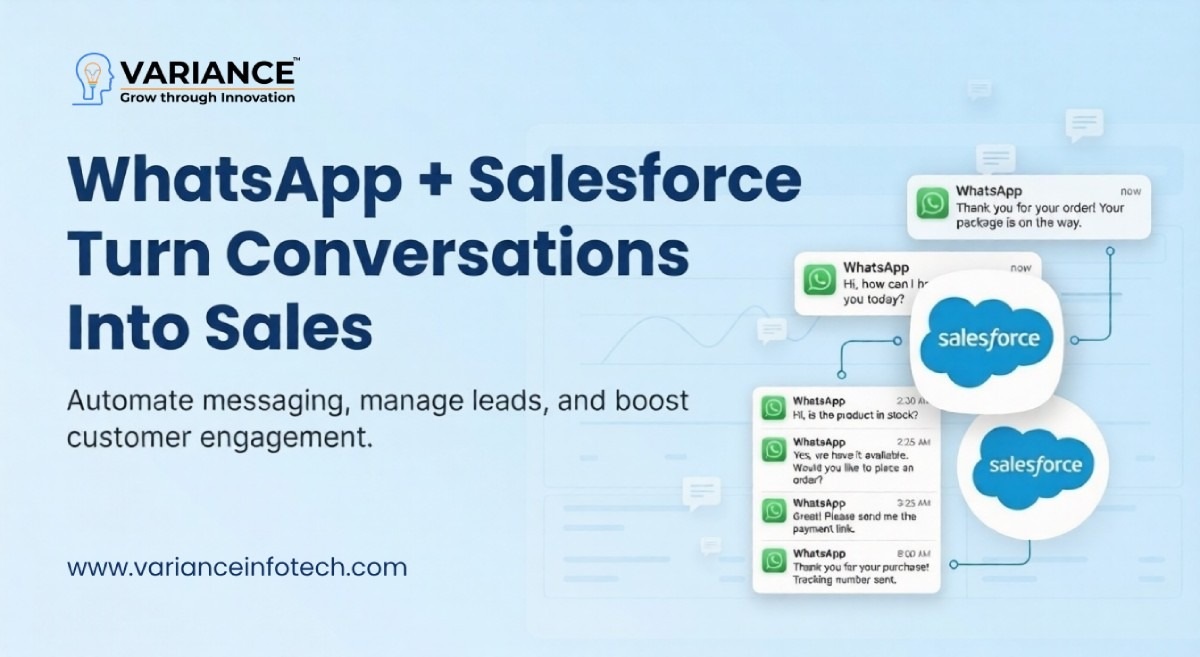
Communicating with customers has changed dramatically in recent years. People don’t want to read long e-mails or be on hold for customer support calls. They want answers fast and to be able to speak with companies in real time via the messaging app.
WhatsApp is the most popular messaging app in the world among all messaging platforms. WhatsApp is gaining ground in the business world, with everything from sole traders to multinational organizations using it to make an instant connection with customers.
Managing thousands of customer conversations manually, however, can be challenging. This is where the integration of Salesforce with WhatsApp comes into the picture. Integrating WhatsApp with Salesforce CRM allows businesses to engage their customers more effectively, manage conversations, monitor customer interaction, and turn inquiries into sales.
This tutorial details the mechanics of a Salesforce WhatsApp integration and how brands can transform everyday conversations into real revenue.
Why Businesses Are Using WhatsApp for Customer Communication:
WhatsApp has turned out to be one of the most favored communication platforms. Customers are already using it daily to connect with friends, family, and colleagues, so it’s a logical channel for business communication too.
Businesses that use WhatsApp to communicate tend to see a faster response and more engagement than traditional means such as email.
Users are more comfortable asking questions in a messaging app, which is more of an opening for businesses to start meaningful conversations that can help a potential buyer make a purchase.
What is Salesforce WhatsApp Integration?
Salesforce WhatsApp integration is a third-party app that allows you to access WhatsApp in your Salesforce environment. Instead of juggling between applications, companies can handle WhatsApp messages straight from their CRM.
With the integration, organisations can save customer conversations, follow the communication history, automate replies and qualify leads in Salesforce.
Both sales and support teams have complete visibility of customer interactions, so they can more easily deliver personalised responses and quicker resolutions.
Turning Customer Conversations into Sales Opportunities:
Among the Salesforce WhatsApp integration benefits is the fact that you can turn simple conversations into structured sales opportunities.
When a customer messages inquiring about a product/service, a lead can be automatically created in Salesforce. Sales reps can then follow up with customized communications, product details, and promotions.
Rather than losing potential customers to delayed responses or overlooked queries, businesses can connect with prospects right away and lead them through the sales funnel.
This greatly enhances the probability of turning queries into customers.
Automating Customer Communication:
Replying to every customer message manually can be a lot of work. Automation allows companies to handle a large number of conversations without compromising the speed of replies.
With Salesforce WhatsApp integration, a business can automate many interactions like welcome messages, appointment confirmations, order updates, and FAQs.
For instance, if a customer sends a message asking about prices or stock levels, automated responses can immediately answer the inquiry while the sales team drafts a more detailed reply, if necessary.
Automation helps maintain a high-level of customer response time for customers and the support team’s productivity.
Providing Personalized Customer Experiences:
Customers expect businesses to know them and what they want. Personalized communication builds stronger relationships and trust.
As Salesforce holds valuable customer data like past purchases, interaction history and preferences, companies can leverage this information while having WhatsApp conversations.
Sales agents have the possibility to send product recommendations, follow-up messages or offers personalized for each customer. This allows conversations to be more natural and contextual instead of being bland sales pitches.
Personalized communication is more likely to result in higher levels of customer satisfaction and better conversion rates.
Improving Customer Support with WhatsApp:
Customer support teams also see tremendous benefits with Salesforce WhatsApp integration. Support agents can respond to multiple conversations and get customer history in one place before replying.
If a customer raises an issue through WhatsApp, a support ticket can be generated automatically within Salesforce. it makes sure that each problem is followed and fixed.
Quicker resolution of problems enhances general customer experience and enables companies to develop enduring relations with their customers.
Real-Time Updates and Notifications:
Customers like to be kept in the loop when it comes to their orders, payments, or service requests. Businesses can now use the Salesforce WhatsApp integration to send automated updates at various stages of the customer journey.
Customers are notified, for example, of order confirmations, shipping notifications, payment reminders, or appointment schedules.
With these real-time alerts, your customers stay engaged and are less likely to call support for status updates.
Tracking Performance and Customer Insights:
Conclusion: Another benefit of using WhatsApp within Salesforce is the tracking of performance and communication data.
Companies are able to track key metrics, including response time, message engagement, conversion rates, and customer health.
These insights enable firms to track customer behavior and enhance their communication strategies on a continuous basis.
With the analysis of conversational trends and feedback from customers, companies can enhance their sales strategy and deliver an improved customer experience.
Why Salesforce WhatsApp Integration Matters for Modern Businesses:
In the competitive digital age, businesses cannot rely on traditional avenues of communication. Customers now want faster responses, more personalized conversations, and easier ways to communicate with brands.
Salesforce WhatsApp integration enable business fulfill these high expectations by offering the power of CRM data combined with ease of use of instant messaging.
Businesses that embrace this strategy generate stronger customer relationships, quicker responses to inquiries, and more conversations that turn into revenue.
Final Thoughts:
WhatsApp has evolved from a messaging app for personal communications. It’s now a powerful business tool that allows companies to communicate with customers in real time.
When connected to Salesforce CRM, it is further enhanced to give companies the power to manage conversations, automate communication, and track every customer interaction.
Through smart use of Salesforce WhatsApp integration, companies can turn even ordinary customer conversations into valuable sales leads, improving the customer experience at the same time.
For those organizations that want to enhance engagement, facilitate communication and generate even more revenue, this integration will provide a simple yet effective solution.
Do You Need more information?
For any further information / query regarding Technology, please email us at info@varianceinfotech.in
OR call us on +1 630 534 0223 / +91-7016851729, Alternately you can request for information by filling up Contact Us

 Please wait...
Leave a Reply